By Craig Knoche
French economist Thomas Piketty and his colleagues Emmanuel Saez and Gabriel Zucman have, in a series of papers going back to 2003, documented what they argue is a large and ongoing increase in the share of income in the U.S. going to the top 1 percent, and even larger increases in the share going to the top 0.1 or 0.01 or even 0.001 percent. Inequality, according to their data, is rising, and it’s rising faster the higher up the income scale you go. Their data helped popularize the notion that the 1 percent is pulling away from the 99 percent beneath them. Just look at the number of U.S. billionaires. There were 66 in 1990, now there are over 700. And CEO pay is up more than 900%, even counting for inflation, yet the average worker’s pay is up only 12% over that time.
The mainstream media picked up their research and exclaimed “Rising inequality: Janet Yellen Tells it like it is,” – New Yorker, 10-17-2014; “Wealth Inequality Is Higher Than Ever,” – Jacobin, 10-1-2017; “U.S. Income Inequality Worsens, Widening to a New Gap,” – NPR, 9-26-2019; and Thomas Piketty Thinks America Is Primed for Wealth Redistribution, NYT, 4-1-2022. Figure 1 (below) illustrated the point.

Their remedying for this corrosive wealth disparity is, in short, tax the rich and redistribute the wealth in the form of government benefits like the Earned Income Tax Credit for low-wage workers.
See the appendix (below) for further reading on this line of argument.
More recently, many economists have counterclaimed that, Piketty and Saez’s contained methodological errors and, more significantly, neglected to include pension, social security, and other transfer payments in their analysis. By including these, there are still trends toward higher wealth and income inequality, but they are more moderate than claimed by Piketty and Saez. The right-of-center publications exclaimed: “The Myth of American Inequality: How Government Biases Policy Debate,” “Was the Panic over ‘Income Inequality’ a big mistake,” “A Distorted View of Wealth Inequality,” and “Inequality and the Piketty Accounting Error.”
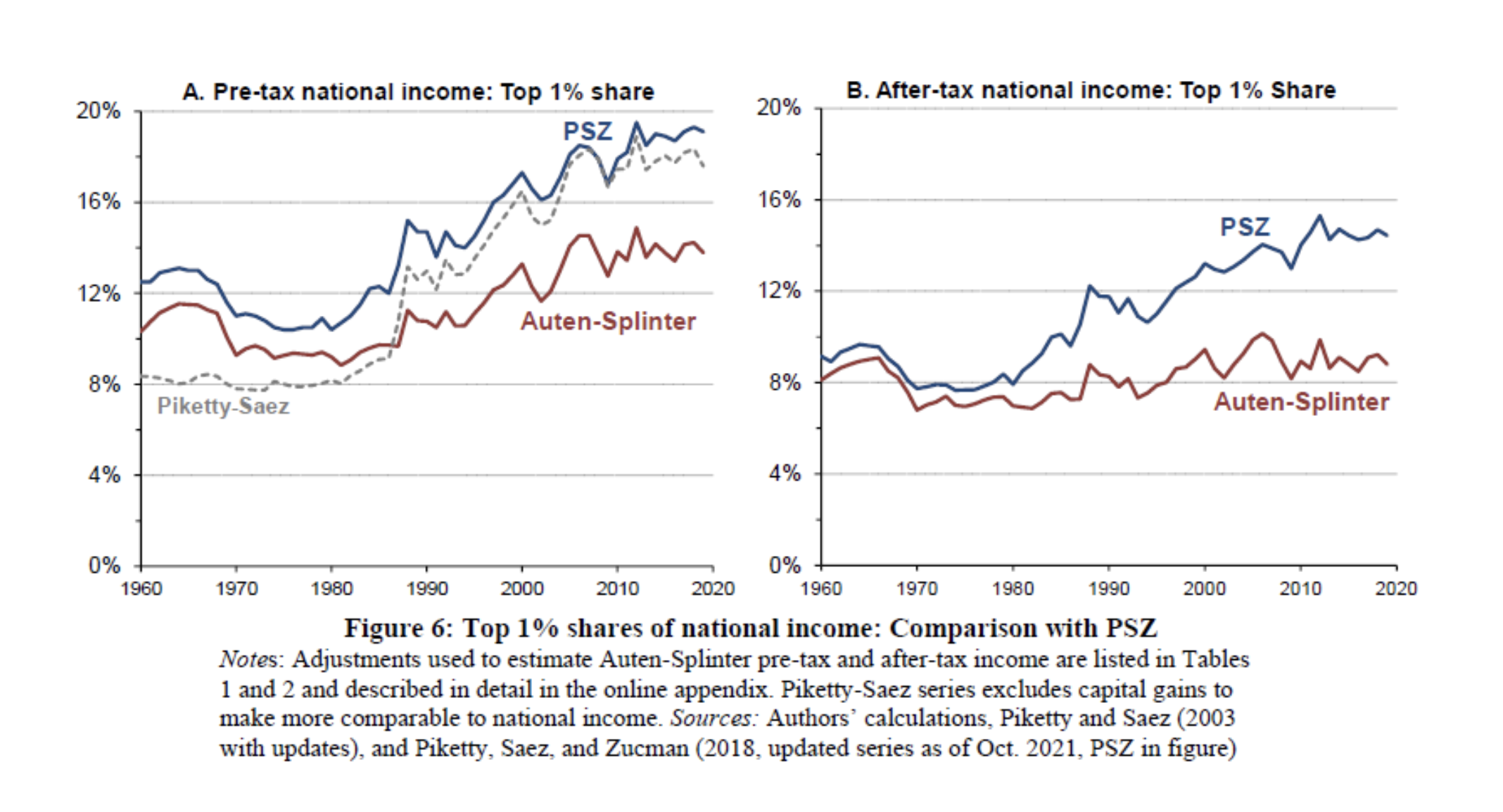
The most significant study came from Gerald Auten and David Splinter of the U.S. Treasury Department and U.S. Joint Committee on Taxation. While they agreed that inequality has increased, they were less certain that the top 1 percent’s share, or that of the top 10 or 0.1 percent, had increased. (Notably, this is a different question from whether inequality overall has grown, because income gaps can also show up within the bottom 90 percent.) The different perspectives are summed up in this second chart (below), comparing Auten and Splinter’s study compares with that of Piketty, et al.
We at the Hayek group make no claims as to the truth of any of these economists. Rather, we include links to their studies and commentaries below.
Articles citing large and growing income inequality
Income inequality in the United States, 1913-1998, T. Piketty and E. Saez, Quarterly Journal of Economics, 2003
Income Inequality in the United States, 1913-2002, T. Piketty and E. Saez,
Capital in the Twenty-First Century, T. Piketty, 2013
Capital is Back: Wealth-Income Ratios in Rich Countries 1700-2010, T. Piketty and G. Zucman, The Quarterly Journal of Economics, May 21, 2014
Piketty’s Inequality Story in Six Charts, J. Cassidy, The New Yorker, 3-26-2014
Inequality in the long run, Piketty and Saez, The Science of Inequality, 5-23-2014
A battle over inequality in the US is brewing among top economists | Vox
“Rising inequality: Janet Yellen Tells it like it is,” J. Cassidy, New Yorker, 10-17-2014
“Wealth Inequality Is Higher Than Ever,” M. Bruenig, Jacobin, 10-1-2017
A new study says much of the rise in inequality is an illusion. Should you believe it?, D. Matthews, Vox, 1-10-2018
“U.S. Income Inequality Worsens, Widening to a New Gap,” B. Chappell, NPR, 9-26-2019
“It’s Been Another Decade of Income Inequality In The U.S.,” D. Wessel, NPR, 1-1-2020
Thomas Piketty Goes Global, I. Kahloon, New Yorker, 3-2-2020
“New Rand study quantifies cost of rising U.S. inequality,” D. Brancaccio and D. Shin, Marketplace, 12-8-2020
“Global Income Inequality, 1820-2020,” T. Piketty, 1820-2020, 2021
“Global Income Inequality,1820–2020: The Persistence and Mutation of Extreme Inequality,” T. Piketty and Chancel, Journal of the European Economic Association, 2021
Thomas Piketty Thinks America Is Primed for Wealth Redistribution, D. Marchese, NYT, 4-1-2022
Do we really live in an “age of inequality”?, D. Matthews, Vox, 1-11-2024
Articles critical of the “large and growing” income inequality thesis
Review and Critique of Piketty’s Capital in the Twenty-First Century, M.J. Warshawsky, Mercatus Center, 06-2016
A Distorted View of Wealth Inequality, Editorial Board, WSJ, 7-30-2021
Inequality and the Piketty Accounting Error, P.W. Magness and V. Geloso, WSJ, 9-18-2023
Social Security and Trends in Wealth Inequality, S. Catherine, M. Miller, N. Sarin, Journal of Finance, 2-29-2020
Wealth Concentration in the United States Using an Expanded Measure of Net Worth, L. Jacobs, et al, Oxford Economic Papers, Vol.74, Issue 3, July 2022 [A PDF download is available from the U.S. Federal Reserve Bank of Boston]
The Myth of American Inequality: How Government Biases Policy Debate, P. Gramm, R. Ekelund, and J. Early, 2022
Impoverished by “Equality”, A. Shlaes, City Journal, 11-8-2022
Income Inequality in the United States: Using Tax Data to Measure Long-Term Trends, G. Auten and D. Splinter, Journal of Political Economy, 9-29-2023
About that growth in Inequality, V. DeRugy, National Review, 12-1-2023
Was the Panic over ‘Income Inequality’ a big mistake, B. Polumbo, National Review, 12-20-2023
A Reckoning for the Rising-Inequality Narrative, J. Hartley, National Review, 12-28-2023
Hours worked and lifetime earnings inequality, A. Bick, A. Blandin, R. Rogerson, National Bureau of Economic Research, September, 2024
More Truth About Income Inequality, Editorial Board, WSJ, 10-7-2024
The effect of taxes and transfers on low-earning worker’s Income, S. Winship, American Enterprise Institute, 10-02-2024