by Ervan Darnell
Summary: The allure of free things and the moral supposition some things should be free leads to bad outcomes, with internet technology bringing us pernicious examples in the form of privacy intrusions.
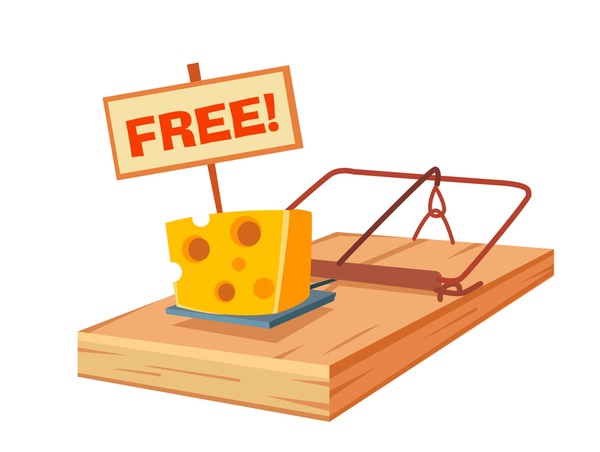
TANSTAAFL: There Ain’t No Such Thing As A Free Lunch. It’s an old adage expressing the idea that superficially free things have a hidden cost. It arises in many forms, advertising gimmicks, price controls, and internet services.
Advertising gimmicks are obvious examples: “three for the price of two” is a trap, when you only need one, and the profit is still higher for the seller by selling “3 for 2”. “No interest for 90 days” is a hook to get you to spend now instead of being prudent, and a double hook in hopes you miss the deadline and thus pay even more. These are obvious examples of a barely concealed cost, not free at all
Shared resources is another variety, especially seductive to a communitarian perspective. It is not a scam per se, but rather an honest effort to be more equitable or perhaps to reduce transaction overheads. But the extra you can take is the “free” part that leads to a bad outcome. The classic thought experiment is everyone shares the field, works together, and harvests together. The reality is some will do little work, some will take most of the harvest, and the net result is more hunger as the field is not productive and what yield there is goes to those who want (or need) it less. People are not honeybees. A modern American example of the same phenomenon is pollution ( “negative externalities” in economic language). Absent a price model that covers the damage, companies will dump, for instance, PFAS in the water, or lead from gasoline in the air, free to them but the cost is borne by someone else. This is not a market failure, this is a failure to recognize property rights in the first place. It’s a failure of thinking something can be had for free.
Advertising gimmicks and pollution are obvious. More subtle is the problem of price fixing. Rent control is a little bit of “free” by holding the price below market rate. But the consequences are housing supply and maintenance both fall on the supply side. On the demand side, housing is hoarded because renters are not fully incentivized to share housing. In the larger economy, people are locked into housing which is not really where they want to live, cannot move for better jobs, and block other people from moving in who could work more effectively in that region. Trying to pretend something can be made free will not work. TANSTAAFL.
As bad as those are, there is something especially pernicious about totally free. Dan Ariely conducted an experiment selling Lindt truffles and Hershey’s kisses[1]. He measured that people preferred the truffle by about 26¢, without great regard to the absolute price. That is, 51¢ versus 26¢ and 26¢ versus 1¢ showed the same preference. But when the price dropped to 25¢ and free, people preferred the Hershey’s kiss. As a value measurement, this cannot be right. Rather, there is some special psychology to totally free that tricks people.
The internet has created new problems with “free”, especially the totally free idea.
Email is free (the marginal cost per email after paying your ISP). But, the real cost is spam and scams. The cost of spam is huge. There is the technology cost to fight it, the personal frustration and time loss, the missed valid emails because of frustration, and most dramatically the fraud cost. 13 years ago the AEA estimated the cost at $20B/year[2], it is now surely much higher.
This could be solved by charging 1¢ per email. The response rate on spam is so low even such a minor charge would kill the economic model for spam. An average emailer sends maybe 10 emails per day for a monthly cost of $3. That would be well worth it to stop spam. Even that is overstated because ISPs could lower their monthly fees by the average email cost (if you used your ISP’s email server). But the psychology of paying for email instead of having it “free” is so strong that there is no way to transition to this system. Yes, changing the email system to have micropayments at this point would be very difficult technically However, new messaging systems (e.g Whatsapp, Telegram, Signal) could easily do this. They don’t, for the same reason.
Internet wisdom: “If you are not the customer, you are the product.” There are consequences beyond poor personal decisions and subsidy cost distortion of “free”. Even expensive systems like Facebook never tried to charge for their service because Mark Zuckerberg understood full well people would not pay even a small amount for an online service. The cost is Facebook is tracking you [4] through your other apps, tracking your location even with location permissions turned off, and tracking non-Facebook users. You paid with your privacy.
Your mobile phone is a tracking device. A commercial example: Allstate gave away a weather app [3] so it could track driving behavior. A government example: A Muslim prayer app was funneling data to U.S. intelligence agencies[5], (even if you approve of that investigation, the users of the app were tricked and that is the point here). The examples are legion. The same is true for many websites. Yes, paid sites and apps often sell your data too, but less often and you do have some control over it (e.g. the paid service Proton VPN maintains privacy versus free VPNs selling your data)[6]. TANSTAAFL.
Richard Thaler gave us the idea of “transactional utility”,[7] which explains how consumers are tricked by fake sale prices because they are measuring value against expected price rather than personal utility. In the case of a “sale” on jewelry, the merchant is still making a profit but the consumer feels like they got a bargain. The situation is even worse when the profit is hidden. For instance, Roku (the media streaming device) loses [8] money on the hardware but makes a fat profit selling your data. The consumer thinks they are getting a discount and are wildly unaware of the merchant’s actual profit. That effect likely applies even stronger with “free” apps, where the user feels like they are getting something fun or useful for “free”, but the real cost is hidden.
The emotional instinct that some things claim to be discounted, free, or even worse “should be” free must be resisted with a cold dose of reality, both in making personal choices, and in resisting the allure of regulatory imposition.
[1] https://danariely.com/the-nuances-of-the-free-experiment/
[2] https://www.aeaweb.org/articles?id=10.1257/jep.26.3.87
[3] https://www.theregister.com/2025/01/14/allstate_accused_of_paying_app/
[4] https://umatechnology.org/facebook-admits-tracking-users-even-with-location-permission-off/
[6] https://www.tomsguide.com/computing/vpns/60-percent-of-free-vpns-could-be-selling-your-data-by-2025
[7] https://newristics.com/heuristics-biases/transactional-utility
[8] https://www.wolfonwealth.com/p/how-roku-makes