by Ervan Darnell
Summary: FEMA is wasteful agency, not serving it’s real purpose, and acting only as taxpayer-funded insurance program, often taxing the poor to subsidize the rich. It should be abolished, not reformed.
President Trump proposed (in his budget) cutting $646 million [1] from the FEMA budget of $29,000 million [2], or 2%. “Discretionary” spending is $1,800,000 million [3] and the deficit is $1,900,00 million [4]. So, we need to cut 105% of every “discretionary” program to balance the budget. 2% seems like a modest start (yes, we need to cut “mandatory” spending too, and there will be tax increases).
It’s not just that we need to cut the budget, FEMA is a pointless agency. Is it, oh say, hardening communication infrastructure against terrorist attack? Nothing remotely like that. One need only look at the Katrina disaster: “Agencies could not communicate with each other due to equipment failures and a lack of system interoperability. These problems occurred despite the fact that FEMA and predecessor agencies have been giving grants to state and local governments for emergency communication systems since the beginning of the Cold War.” (and many other examples of inept bureaucracy) [7]. In other words, with a $29,000 million budget they didn’t even test to see if their radios worked, least of all research or deploy better communication infrastructure for critical services.
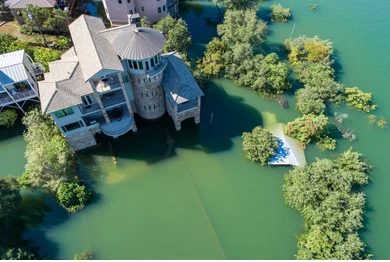
Even if the radios worked, FEMA’s job is handing out checks after the fact to people who built in disaster zones (for instance condo towers[5] or vacation homes [6] in flood prone beach areas). It’s a “moral hazard”, that is, it rewards mistakes. It’s not just a waste of money it causes harm by encouraging bad behavior.
Nonetheless, there is outrage, e.g. CBS writes “[the cuts would] hammer communities that voted for Trump” [11].
Even were FEMA not wasteful and subsidizing folly, there is no reason for the federal government to fund it. Montana sees few hurricanes and Florida few forest fires. Why are they forced to subsidize each other through federal taxes and the federal budget? The cause organization NRDC[8] objects to it this way “States and local governments depend on FEMA to recover from disasters…FEMA obligated $35 billion in funds to state and local governments ” . The more respectable left-leaning policy magazine “The Atlantic” makes a similar observation indirectly “[States] just can’t do it without an infusion of FEMA dollars and expertise when the disaster is too big.” [9].
They are both wrong. The federal government gets its money from states in the first place by taxing away the income of state residents. What the federal government does not tax away states have available to spend on their citizens. They can spend it more efficiently without an extra layer of bureaucracy. One might object there was no explicit tax cut that came with the FEMA cuts. Not directly, but there is implicitly a tax cut in the form of fewer tax increases to continue paying for the program in the future.
That logic can be iterated. Why are states taxing the poor to subsidize the rich via disaster bailouts? Let the rich buy their own flood and fire insurance. If they cannot afford it, the market is telling them something. Or, if they want to risk the capital on a vacation home, let them, but that is no reason for taxpayers to bail them out. But “what about the poor?” This is a fixable problem: make insurance mandatory if you cannot demonstrate sufficient assets to suffer the loss (the same way we have “accredited investor” status now). “But they cannot afford the insurance”. That means they should move because it’s too expensive to maintain a residence in a high-risk place. Regardless, this is already the law [10] that people cannot build in high-risk zones. So, there is no moral problem to fix in the sense we are already willing to tell poor people they cannot live in such areas.
At the bottom of this we are left simply with wanting more welfare for the poor. If that’s the case, there is a simple fix: insurance vouchers for poor people, just like we have food stamps now, sufficient to cover ordinary housing in reasonably safe places. With that, the incentives are nearly all in the right place. People have an incentive not to build in dangerous places. The rich carry the burden of vacation homes in flood zones. States are empowered to spend the money in a way most useful for the risks they face, and the poor are not impoverished while still having an incentive to avoid high risk housing. We can abolish FEMA.
———————
[1] https://www.axios.com/2025/05/21/trump-fema-hurricane-season-disasters
[2] 2023 budget: https://www.dhs.gov/sites/default/files/2022-03/Federal%20Emergency%20Management%20Agency_Remediated.pdf
[3] https://www.cbo.gov/publication/61184
[4] https://www.cbo.gov/topics/budget
[5] condo towers on the beach: https://www.nbcnews.com/news/investigations/why-taxpayers-will-bail-out-rich-when-next-storm-hits-n25901
[6] Stoessel being even more blunt about insuring rich people: https://www.youtube.com/watch?v=Uvn7WO2pDBk&t=40s
[7] https://www.cato.org/blog/hurricane-katrina-remembering-federal-failures
[8] https://www.nrdc.org/media/trumps-cuts-fema-leave-us-unprepared-disasters
[9] https://www.theatlantic.com/science/archive/2025/06/fema-states-disasters/683103/
[10] ” the Flood Disaster Protection Act of 1973, which made the purchase of flood insurance mandatory for the protection of property within SFHAs.” https://en.wikipedia.org/wiki/National_Flood_Insurance_Program
[11] https://www.cbsnews.com/femagrantcuts/